Leaders as Teachers

A lot has been written which implies leadership means helping others to succeed – but is that the same as being a teacher?

How many business professionals have dedicated time to learning how to teach verses how many do it by instinct alone? You may have learned how to give an inspiring speech, but does what you say teach people anything new?

The following 7 tips will help you be a better teacher to your audience, able to not only inspire them to action, but help teach them new skills and techniques you’ve learned along your career.

  1. Ask For Feedback:
    It’s the number one step for anything in leadership. If you want people to leave a session with you having learned something, you best check your success. Survey your attendees, find out what they’ve taken away with them they didn’t have before.
  2. Tell Stories:
    If you’re teaching, bring in real world stories to support your key points. Let people see you embrace continuous learning by sharing examples of when you’ve learned something outside of the workplace. Maybe you learned something about the power of the receiver in communication through your children? Perhaps you noticed an interesting consumer behaviour in the supermarket? These stories help people remember the key message and humanise the content.
  3. Prioritise The People:
    Getting your audience engaged and active is important to their learning. A good rule is to never go more than 10 minutes without having people participate or engage somehow. Invite them to ask questions, then move over to the person who asked the question and talk with them directly. Get people moving about, even if it’s just a quick show of hands. Encourage them to reflect on a personal experience and give them time to really do so.
  4. Be An Authentic Expert:
    Know why these people should be listening to you. Ask yourself this before you being preparing and be able to sum it up in one sentence. Why are you the right person to be talking about this? Understanding where your role as ‘expert’ is coming from will help you clarify your teachings in an authentic way.
  5. Have Fun:
    Everyone will take something different from this. I naturally laugh, a lot. So I’ve embraced it as part of my business style. You might not think my jokes are particularly funny but you’ll see the energy telling them gives me, and energy begets energy. Understand what gives you energy and use it in your teachings. Don’t be afraid to engage with the content in playful ways or use fun scenarios to demonstrate a point.
  6. Prove You’ve Planned
    Don’t just have a plan, outline it at the beginning. Let people know what they’re in for. Kick things off by sharing the ‘chapter headings’ or key learning points. This will help if your attendees have specific questions to know when to ask them. It will also make sure you hone in on what’s important in each section and keep you on track.
  7. Conclude It:
    Your conclusion is as powerful as your introduction. With a strong, meaningful ending you can ensure participants leave encouraged to develop on what you’ve given them and continue to ponder and engage with it in the days to come.

Leaders who are also good teachers add so much value not only to their business, but to the people who surround them. With these simple tips you can help others to learn and improve.


Moving your business online? Get strategic.

Your business was doing just fine in its physical premises, but you’ve decided its time for phase two. An online presence.

It makes sense, lower operating costs and a 24/7 global market. But its not as simple as wix would have you believe. Before you sign up for your 30 day trial, you need to get a plan in place. What exactly do you want your website to do? Brand awareness, sales, knowledge sharing, building a community. It your website all about generating revenue or building a reputation? These decisions will impact the type of website you design, where you chose to host it and all the links into those all important social media platforms.

Do you want your website sales to out perform your existing high-street sales? Or for it to act as a top up? Will you be selling online at all? Answering this will help you plan out your budgets.

If you want your website to drive more traffic to your store, then make sure its interactive. Customer generated comments are more convincing promotions than any advert you could come up with. Also people will need a way to easily chat with you. All of this might mean opting for a Facebook page, rather than all bells and whistles website is the way to go.

Would you like to be able to send people content about sales and special offers? Then you need to get their email addresses. You’ll need to offer something in exchange for their information tho. You should decide if you’ll be regularly creating content that people will look forward to, if not then don’t get fixated on creating a mailing list.

Then you’ve got to think about what your audience want. Profile who you want to be visiting your website, their age, hobbies and where they’re likely to spend their online time. Are they using a mobile devise to browser, tablet, laptop or desktop? Again this determines how your website should be set up so it looks best on the devise your visitors are using.

If you think this feels like a lot of work, it isn’t. It’s just about having a plan before you act and start spending your hard earned money which is the key to sustainable business growth.

Communication is Key

Imagine a company with two identical sites, both sites roll out the same pay change. It gives the employees a significant pay rise by removing a complicated bonus structure and replacing it with a much higher basic hourly rate.

Site A gets 100% agreement from staff to move to the new package, everyone is really pleased and overall morale goes up. Site B only gets 30% of staff moving to the new scheme. Staff at Site B are suspicious and immediately look for how they’re being hard done by. Eventually nearly all of those who did move over at Site B demand to move back to the old structure because they’ve heard from other’s they’re losing out.

It may sound ridiculous, but I watched this scenario play out and over 50 people chose to be financially worse off because of how things were communicated.

There was nothing magical about Site A. The manager prepared his figures in advance, had a one on one meeting with each member of staff two months before the proposed change and gave them time to ask questions and think about it.

By contrast the manager at Site B told us he was having those meetings, but didn’t. Then on payday – after the change had been put in place – he told a lower manager to inform staff what had happened while handing out payslips.

So, why did they do things so differently when they received the exact same guidance and advice? The manager at Site B isn’t the world’s worst manager but he did have a history of bad experiences with staff. In the past when he’d tried to do something good for them one or two were very vocal about how he should do more, or that it should have been done earlier. And, he never got positive feedback from the majority, so understandably was left feeling disheartened.

Rather than continuing to practice communicating with staff and getting their buy in on change, he started doing things behind their backs. If he didn’t give them warning something was changing, they wouldn’t be able to get angry about it. And in turn they learned not to trust him.

This approach is all too common. If we have a bad experience our brain want to protect us from it by not encouraging us to do it again. So we stop trying the exact thing we need more practice with. You can learn more about how our brain hinders our development in my post “Tell People Your Weaknesses”.

Communication takes constant practice. Just because you’ve done it well in the past, doesn’t mean you never have to do it again and definitely doesn’t mean you have nothing more to learn. You’ll need to put constant effort into giving your team the right information at the right time, and you won’t always get it spot on but they will build trust in you and forgive you when you might get it wrong.

To be a great communicator you should give your staff the information they need to do their jobs well and to feel good about being a member of the team. That’s a team you’re a part of too, so communicating with your team should make you feel good as well.

You also need to give them information in a timely way, wherever possible talk to them before a decision or action is due. Give them the time to reach their own conclusions and input on the final outcome. If you’re making good choices they’ll come to the same conclusions you have.

People say the worst thing you can do as a leader is communicate too little, too late. But you can also communicate too much and too soon. This happens when you don’t have the appropriate information to help the person you’re talking to reach a conclusion. When this happens, instead of causing suspicion and rejection which happens when you don’t communicate enough, you might cause panic and fear which will be just as damaging.

People need to feel empowered and communicating information allows them to make decisions and choices for themselves. As a leader communication is an important part of your role and practising great communication will be key to your future success.

Jenny Sanders

Where Are Your Future Leaders?

It can be almost impossible to see your current junior staff as tomorrow’s senior staff but if you don’t give them the chance, someone else will.

But it’s not just about losing good staff. Can you really afford to commit future time and money into recruiting from the outside if someone key leaves unexpectedly?
It sounds like a no-brainier but how much further could you be on your company road map if you hadn’t needed to recruit and on board key staff in the past?

Many leaders still dismiss the idea that their talented younger staff can be their strong future leaders, but that’s because they’re not seeing the potential today. They’re only looking for it when it’s already too late.

Yes, sometimes you do need to hire from the outside. Doing so brings in brand new skills, a fresh set of eyes, helps generate new ideas and improvements to your business. But sometimes hiring from the outside means you’re overlooking the staff you already have and that’s the quickest way to lose them.

Objectively examine the people within your business not currently at a management level. Now imagine they’ve left you and gone on to another role in a different company. Do you see a side step into a similar role – or have they gotten something better? Now imagine they’ve moved again. In two job’s time are they more senior still? If the answer is yes, then they should be your future leader, instead of being someone else’s.

Here’s where having a robust succession planning strategy is critical. Take the time today to identify your back up plan for all key staff and it will save you valuable time down the line. But you need to start today.

Have open and honest conversations with your high potential staff to understand where they want to be and don’t be afraid to talk about the future with them. Of course this means embracing transparency to a degree. If you’re preparing them for a management position, tell them so, but also tell them in how many years time you think it will be before they’re ready and the skills they’ll need to work on. Make sure they know the goal posts will move but that you’re committed to them and their progression.

Personal Development Plans are one of the best tools for upskilling staff, and done right, they don’t create an abundance of work for you to manage. With clear goals and timelines the employee can go on their personal journey, touching base with you regularly to provide updates and ask for guidance if needed.

A good PDP should start with what skills the business needs, but the employee should provide the how, when and where they’re going to get those skills. Your employee should take control of their own learning, knowing that you’re going to support their career progression and give them opportunities as they arise.

Focus conversations on flexibility and long term strategy. That way you and your junior staff will go forward knowing that what their working towards isn’t set in stone but there will definitely be progression, development and leadership in their future with you.

3 Monthly Management Exercises

3 things to do each month to become a better leader

  1. Make product feedback a part of daily life.

As a leader you likely have a lot of ideas for your product with not enough time or resource to test them all. So, asking other’s for their ideas might seem like a waste of time knowing their suggestions may take months or years to get implemented, if ever.

But, if your business or team has grown beyond a handful of employees then you’re not on the front line anymore, which means those who are definitely know something about the product(s) that you don’t.

Unless you’ve done a fantastic job of letting go of the emotional connection most people feel towards what they’ve built, you’re likely behaving in a way that limits rather than encourages honest feedback without even realising it.

You can improve your company’s performance immediately by having frequent, honest conversations about the positives and limitations of the product.   Ask people to challenge your assumptions, point out flaws of what’s been built and (this is the important part) praise them openly when they do so.  You may not act on all of this feedback but your front line need to feel empowered to challenge the status quo if you’re going to continue to improve.

2. Play with data

It’s easy to get bogged down by reporting routines. Once you’ve found your company KPIs / OKRs / Traffic Light data points you might feel secure that month on month you’re making the right decisions because you’ve the data to back them up.

However, if you’re only looking at the data in the same format you’ll always be comparing the same data points against each other. This isn’t a bad thing but it will mean if you’re making any assumptions they may go unchallenged for some time.

Instead you spend some time playing with your data. Try re-phrasing some of the questions you ask of your data or pairing up data sets that don’t normally sit alongside each other. You never know what you might see until you start looking for it and if you demonstrate this data curiosity your team will follow suit.

3.. Make your own performance visible

People leave jobs because of their relationship with their boss. It comes up as the number one reason, year after year. As managers we’re clearly doing something wrong, and we keep on doing it!

You spend a lot of time really focused on what those in your team are doing. You get involved in their work, challenge them to improve and review their overall success regularly and sometimes it can feel like a one way relationship.

Ask yourself (and your team) what do they know about your workload? Do they understand the pressures you might be facing and do they see you as a fallible human who has bad days? Or are they holding you to the highest of standards, which means they can take offence when you’re not perfect.

I don’t mean for you to take every opportunity to tell your team how busy you are or how much pressure you’re under. You’re not looking to spark sympathy (as the boss you won’t find it). Instead put in place a process so the team know what you’re working on and whether you’ve succeeded.

If you can get your team to see you, not just as a manager, but also as someone with deadlines, targets and performance standards to meet you may find that your biggest critics become some of your strongest supporters.

Being a strong leader, when you’re a new manager

You’ve had great successes in your career, possibly even having managed a very small team before.  You get on well with peers and management alike and when you put your mind to something it gets done, and done well.  This is usually when you, or someone else in your company, starts thinking it’s time for you to make the leap to a more senior leadership role.

If this is happening to you in a large, established business you’ll likely have had mentors or a boss who’s shown you what this senior role looks like.  You’ll have watched them take company goals and translate them into departmental strategy and targets. Then you’ve been a part of executing the day to day delivery to achieve success and can say with confidence how strategic leadership delivers real end value.

However, if you find yourself in a fast paced, SME going through rapid growth and you’re being asked to step up into a new role with little to no guidance you may find yourself very quickly sinking with no idea where it all went wrong.

Making the move from being a do-er, to managing a strategy or people is a big change to your day to day.  You’ll need to quickly learn to let go of the more hands on work you’re used to and experience a mind shift for what adding value in this new role looks like.

The biggest point most new managers need to get around is fully understanding that their new work is adding value. But
it can be hard to release the mental connection between creating/ selling or launching things and adding value.

Look to the other members of Management in your company – are they coding, selling or building marketing campaigns? Or are they strategizing, roadmapping and tracking performance of others?  Hopefully you’ll see they’re mostly doing the latter and that, in turn, is the key to delivering the former.

One of the biggest motivators in your career will be knowing where you’re adding value, so when you’re thinking about a more senior position you need to ask yourself if in this new role you’ll feel that you’re adding real day to day value to the company.  If the answer is no, then you’ll find yourself drifting back to the hands on tasks you’ve held in the past and you’ll quickly find that you’re falling behind the new standards expected.

The simplest way to overcome the feeling that your new role isn’t adding value is to talk with those directly above you.  Get really explicit agreement that the things you’re worried about spending your time on are what’s needed.

I vividly remember a conversation I had with a boss where I told him that 60% of my time was spent ‘just talking’ to people.  Rather than confirming my fears that this would be seen as a waste, he asked me what I got from this activity. I soon realised this time spent ‘just talking’ to people meant I had a steady stream of up to date information to feed to him, was able to prevent project overlap before time and money was wasted and I was able to stop people from missing critical elements to their work by having a robust knowledge of all the moving parts of the business.  Since then, I am proud to tell people that most of my role involves talking, and I love dedicating my management time to doing just that.

As soon as you can articulate the bottom line value of those activities you undertake not as a do-er but now as a strategic leader, you’ll be able to throw yourself wholeheartedly into your new role and every aspect of it.

Tell People Your Weaknesses

It helps trick your brain into improving on them!

People like to do what they’re good at.  Annoyingly our brains actively encourage us to do what’s likely to result in success and to shy away from risk, uncertainty and failure. This is why Positive Reinforcement is critical when learning a new skill.

At school its easy. Parents and teachers know you’re trying new things and offer regular praise. But as adults, unless we tell people we’re working to improve they’ll have no idea and aren’t likely to offer any encouragement.

When we’re praised or complimented our ventral straitum (the forebrain) lights up.  This is part of our brain’s reward system and responds similarly to praise as it would to being given money, which you’ll find more about that in my post ‘Words are Stronger than Money’.

Although at first glance it may look like our brain’s reward system is actively designed to prevent trying something new, it’s remarkably easy to use the forebrain to encourage learning and practising a new skill.

Research suggests that, while trying out a new skill such as learning a musical instrument, if the student receives praise they’re significantly more likely to remember what they’ve learned the next time they come to practice. (Sugawawra).

So, how does this apply when you’re working on your weaknesses in the workplace? Because of the way our brains are wired a lot of people try to fix their weaknesses in private. They’ll read up on skills they want to develop, test new methods of interaction and spend a lot of brainpower on trying to figure out if they’ve nailed it yet. All because they don’t want to be seen to fail while they’re trying.

But, what happens if you tell your team what you’re working on? Your brain may very well freak out. Suddenly you’re advertising something you are ‘failing’ at, it may try to convince you that you’ll only receive negative feedback and everyone’s going to think less of you. But what if they don’t?

If you tell key members of your team what you’re working on and how you intend to practice these new skills you can ask them to let you know when you’re doing it well. This praise will make a huge impact on whether you retain and continue using these new skills, or if you give up never knowing whether you’ve improved at all.

This feedback will give your brain a little reward every time you hear that you’re doing a good job or improving. It’s positive reinforcement and it works on every level – even if initially you’ve had to ask for it.

Not only does it compliment the natural wiring of our brains, but it helps to hold you accountable for not slipping back into bad habits. It will also stop you from hitting the wrong notes when you think you’re getting it right – which can then be much harder to unlearn.

Positive reinforcement isn’t just about being nice, it’s about giving someone the confidence to keep going, even if they don’t always get it right. Pick people who you trust will support you in your journey and ask them to give constructive feedback your brain will thank you for. With this small change, learning moves from something to be avoided at all costs to something you (and your brain) love to take on board.

Jenny Sanders

A Strong Company Culture


“Shaping your culture is more than half done when you hire your team.”– Jessica Herrin, Founder, Stella & Dot

Company Culture has only recently found it’s place in the Business Dictionary.  But in the past 20 years it’s become arguably one of the biggest challenges fast growth businesses face and one of the key things keeping leaders awake at night.  So, what is it?

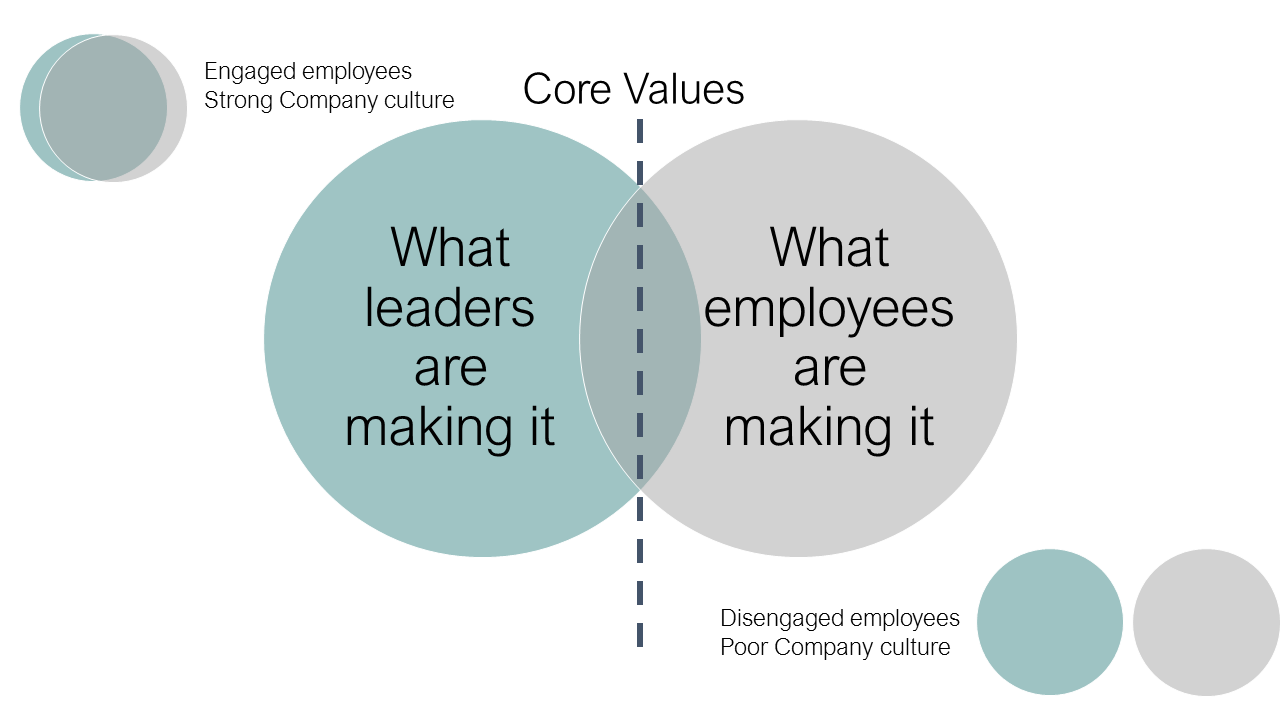
Like everything, when you break it down it’s simple, what’s harder is when you need to change it.  A company’s culture comes in three parts, one strategic goal and two tactical inputs.

The strategic goal is what someone, or better yet many people, decide they want the company’s culture to be, usually expressed as a set of Core Values.  The two tactical inputs are;

  1. What leaders are making the culture.
  2. What everyone else is making it.

A strong company culture occurs when these two tactical inputs overlap directly with the Core Values:

what is culture 1

Problems arise when any of these three elements widely differ from the others.  A leader can talk about a strategic goal but day to day if they’re not inputting the same values through their actions employees quickly lose faith in the company.  The same is true if  employees don’t engage in the strategic direction or are allowed or encouraged to behave in ways which don’t overlap with the core values.

So if you’re looking to define, build or change your company’s culture you should start by examining these three elements.  If you don’t have your Core Values yet, you’ll need to build those and I’ll cover how to do that in another post.  From there gather as much feedback as you can about what behaviours managers and employees alike are inputting day to day.  There’s no such thing as enough feedback at this stage.  Actively hunt out the gaps and misalignment’s and from these build your steps to realign your three elements.

If you find that any one of your three elements isn’t working, don’t be afraid to change it.  Your Core Values  shouldn’t change often, but if they’re no longer representing what feedback says is needed then refresh them.

If your leaders or staff aren’t engaged with the strategy,  start rewarding and recognising people who are.  Build Core Values into your performance reviews and your townhall meetings, pick your employee of the month based on them –  openly praise those who are promoting the culture you want and privately speak to those who need to get their actions to better aligned.

It’s a simple enough formula, but it’s all you really need to start building a stronger Company Culture.

Laura Kelly,